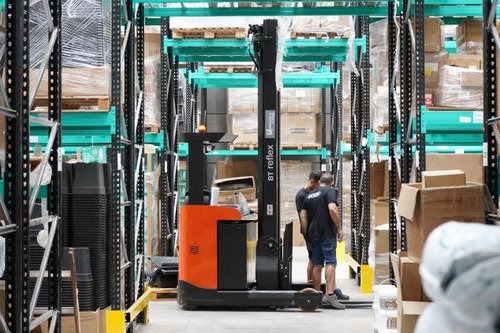
photo credit: GB The Green Brand / Pexels
Key Takeaways
- Workforce wellbeing directly affects operational performance by influencing productivity, retention, quality, and supply chain reliability.
- Musculoskeletal disorders often develop gradually through repetitive tasks, awkward movements, and prolonged physical strain rather than sudden accidents.
- Material and equipment choices impact worker safety, making procurement decisions an important part of injury prevention and workforce sustainability.
- Automation does not eliminate ergonomic risks; it often shifts physical demands to different tasks that still require careful management.
- Organizations that treat wellbeing as infrastructure are better positioned to maintain stable operations, reduce turnover, and improve long-term resilience.
Industrial operations leaders are being asked to move more volume, with tighter labor pools, heavier throughput expectations, and increasingly complex automation environments. In that setting, workforce wellbeing cannot sit off to the side as a human resources program or a compliance file. It is one of the inputs that determines whether a facility can reliably receive, make, move, secure, and ship goods.
Why it Matters
The old safety conversation focused heavily on acute incidents: the fall, the struck-by event, the sudden equipment contact. Those still matter. But in many heavy logistics and manufacturing environments, the quieter threat is cumulative physical wear: the shoulder that loses range of motion after years of awkward reaches, the back strained by repeated load handling, the wrist degraded by daily gripping, pulling, cutting, or twisting. BLS describes musculoskeletal disorders as conditions that can develop when workers use muscles, tendons, and ligaments in awkward positions or frequent activities over time, and manual material handling contributes to a large share of MSD cases involving the lower back, shoulders, and upper limbs.
What Operations Leaders Should Carry Forward
Workforce wellbeing is not softness. It is capacity protection. The practical issue is simple: when physically demanding workflows erode people faster than the operation can replace, train, and stabilize them, the supply chain becomes fragile. Absenteeism rises. Experienced workers leave. New hires take longer to reach full productivity. Supervisors spend more time filling gaps than improving flow. Quality slips because tired bodies make more mistakes. The result is not just a safety problem. It is a throughput, labor, cost, and continuity problem.
The Risk Is Built Into the Workday
Automation has changed a variety of fields, including industrial work, but it has not removed physical exposure. In many facilities, automation has increased the pace around the remaining manual tasks. Workers may lift less often in one area but handle more exceptions, clear more jams, secure more loads, or perform faster repetitive movements between automated steps.
Common exposure points include:
- Repeated lifting, lowering, pushing, pulling, and carrying
- Awkward reaches around pallets, conveyors, racks, or machinery
- High-grip tasks involving cutting, tensioning, bundling, or load restraint
- Long periods of standing, twisting, or working above shoulder height
- Heavy tools or consumables that add strain every time they are handled
Material Choices Shape Injury Exposure
One of the most underestimated levers in heavy industrial wellbeing is the material workers touch all day. Packaging, securing, fastening, and handling choices can either reduce physical friction or quietly compound it. Load securement is a good example. In heavy industrial workflows, strapping decisions often look like a procurement detail. In reality, they affect hand safety, load control, body mechanics, and daily fatigue. Steel banding has long been used for dense or palletized loads, but its weight, sharp edges, recoil behavior, and handling demands can increase exposure to cuts, eye hazards, awkward pulling, and repetitive strain.
For operations teams securing heavy palletized freight, composite strapping is worth evaluating as a safer, lighter alternative. It can provide the tensile strength required for demanding industrial loads while being easier to handle than steel banding. Because it avoids sharp metal edges and rust-related handling issues, the swap can reduce the small, repeated harms that accumulate across a long career. In practical terms, it is not only a packaging decision; it is a workforce durability decision.
Where Wellbeing Becomes an Operating Metric
| Operational area | Traditional view | Resilience-focused view |
| Safety | Prevent recordable incidents | Reduce cumulative exposure before it becomes attrition |
| Labor planning | Fill roles when people leave | Preserve experienced workers by redesigning physical demand |
| Procurement | Buy materials by unit cost | Evaluate handling impact, injury exposure, and workflow friction |
| Automation | Increase speed | Balance machine pace with human recovery and task variation |
| Productivity | More output per hour | Sustainable output without physical erosion |
This is where the financial case becomes clear. A cheaper material, tool, or process is not cheaper if it increases injury claims, overtime, turnover, rework, training load, or missed shipments. Heavy operations already measure machine uptime because downtime threatens throughput. Human uptime deserves the same seriousness.
A Useful Outside Reference for Teams
A practical resource for leaders building an ergonomics program is OSHA’s ergonomics guidance on controlling workplace hazards. It outlines the value of identifying and controlling work-related musculoskeletal disorder risks, including through workplace design and program-level improvements. The resource is useful because it moves the conversation beyond slogans and toward repeatable controls. For operations leaders, it can serve as a starting point for turning scattered safety observations into a structured improvement process.
FAQ
Why should operations leaders own workforce wellbeing instead of leaving it to HR?
Because the drivers often sit inside operational design: workflow pace, staffing models, material handling choices, tool selection, layout, and production expectations. HR can support retention, but operations determine much of the physical exposure.
Does automation reduce the need for ergonomic thinking?
No. Automation often changes where strain appears. Workers may handle exceptions, feed machines, clear blockages, secure finished goods, or keep pace with faster systems. The remaining manual work can become more concentrated and less forgiving.
What is the fastest place to start?
Start with high-volume, high-force, high-repetition tasks. Look for jobs involving load securement, pallet handling, order picking, machine tending, manual packaging, and end-of-line movement.
How should leaders justify investment?
Frame it as continuity protection. Reduced physical erosion can support lower turnover, fewer restrictions, fewer disruptions, better morale, and more stable throughput.
Conclusion
Industrial resilience depends on more than supplier diversification, inventory buffers, and machine uptime. It also depends on whether the people inside the system can keep performing skilled physical work without being slowly worn down. Leaders who treat workforce wellbeing as infrastructure make better decisions about tools, materials, pace, layout, and process design. In heavy operations, protecting the body is protecting the supply chain.