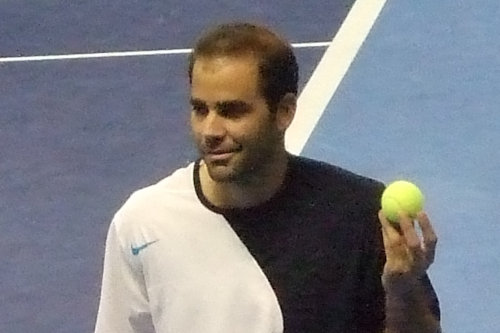
photo credit: Levg / Wikimedia Commons / CC BY-SA 3.0
Key Takeaways
- Pete Sampras redefined all-court tennis by combining a dominant serve with exceptional speed and net attacking instincts.
- His shift from a baseline style to a serve-and-volley game under coach Peter Fischer shaped his championship career.
- The 1990 US Open final against Andre Agassi demonstrated Sampras’ ability to control both baseline rallies and net play.
- Unlike many contemporaries who emphasized side-to-side movement, Sampras used a north-south approach to court coverage.
- His movement style and success on fast surfaces, especially grass, influenced both opponents and later court design changes.
Jeff Scafaro is a labor relations consultant and founder of Vanguard Consulting Group, LLC, based in Cleveland, Ohio. Jeff Scafaro brings more than two decades of experience spanning union advocacy and employer-side labor relations, advising organizations across health care, utilities, education, and public services nationwide. In addition to leading Vanguard Consulting Group since 2015, he serves as director of employee and labor relations at LifeBridge Health, Inc., where he oversees collective bargaining, conflict resolution, and labor and employment arbitration across a large, multi-entity health system.
Before transitioning to employer advocacy, Jeff Scafaro spent 18 years representing employees as a union advocate, negotiating numerous collective bargaining agreements and leading grievance resolution efforts. Outside his professional work, he is an avid tennis player who competes regularly in singles and doubles leagues. His long-standing engagement with the sport provides a natural point of connection to discussions of tennis history, including the playing style and movement innovations that defined champions such as Pete Sampras.
How Pete Sampras Redefined All Court Coverage
Considered the greatest tennis player of his era, Pete Sampras redefined the serve and excelled on grass and the fastest hardcourt alike, en route to 14 Grand Slam singles titles. It stood as a record until Roger Federer broke it in 2009, with seven Wimbledon singles championships between 1993 and 2000 and five US Open titles between 1990 and 2002. The only major he never won was the French Open.
Sampras’ evolution toward his winning style began in his mid-teens under coach Peter Fischer, who shifted him from a baseline style, featuring a two-handed backhand, to an explosive serve-and-volley game with a single backhand. His overpowering serve could generate ball speeds in excess of 120 mph, and he combined this with blazingly fast court coverage and a powerful forehand.
His skills culminated in a legendary 1990 US Open final confrontation against rival Andre Agassi. Here, an ascendant 19-year-old Sampras, two years a pro and under the rigorous training of Joe Brandi, upset favorites such as Ivan Lendl en route to a finals matchup that many believed would be a cakewalk for Agassi. In the semifinals, Sampras took advantage of McEnroe’s serve-volley strategy to send blistering passing shots whizzing by his opponent as he ran up to the net.
After the victory, Sampras’ conditioning enabled him to prepare for his finals match in less than 24 hours. Without time to reflect on the magnitude of the match at hand, he could let instinct take over and play his best. Agassi’s strategy was opposite to McEnroe’s, as he almost exclusively stayed back on the court. This was a way of preventing Sampras from aggressively attacking the net. However, Sampras proved more than capable of countering his, out-dueling Agassi from the baseline, while opportunistically running up and attacking as the situation warranted. He defeated his opponents in straight sets, 6-4, 6-3, 6-2, in only an hour and 42 minutes.
Agassi gave Sampras the ultimate accolade for this match, writing, “We’re playing long points, demanding points, and he’s flawless…. He’s reaching everything, hitting everything, bounding back and forth like a gazelle. He’s serving bombs, flying to the net, bringing his game right to me. He’s laying wood to my serve. I’m helpless.” Fittingly, Sampras also defeated Agassi in his last US Open victory in 2002, as a grizzled veteran at 31.
In his focus on movement and all-court coverage, Sampras emulated early heroes such as Australians Rod Laver and Ken Rosewall. He was not the only player of his era to excel at tracking balls from one side to the other, as attested by Bjorn Borg, Lleyton Hewitt, Rafael Nadal, and Michael Chang. However, while these greats moved on an east-west court coverage axis, Sampras saw the court differently. He took a north-south view of the court, with diagonal, angular, and often unpredictable movement toward and away from the net.
The approach allowed Sampras to shift from baseline defense to a hard charge in the blink of an eye, giving him a particular advantage on the slick grass courts of Wimbledon in the 1990s. Partly as a result of his dominant success, these were replaced with slower grass in the 2000s, as his speed and advantage dissipated.
FAQ
What made Pete Sampras different from other players of his era?
He combined one of the most powerful serves in tennis history with exceptional movement and the ability to dominate both at the baseline and at the net.
How did Sampras’ playing style evolve?
He transitioned from a baseline player with a two-handed backhand to a serve-and-volley specialist with a one-handed backhand under coach Peter Fischer.
Why is the 1990 US Open final considered so important?
The match showed Sampras’ ability to outplay Andre Agassi both from the baseline and at the net, signaling the arrival of a new dominant champion.
What was unique about Sampras’ court coverage?
Instead of focusing mainly on side-to-side movement, he used a north-south, diagonal approach that allowed rapid transitions from defense to attack.
How did Sampras influence the game beyond his titles?
His dominance on fast surfaces, especially grass, contributed to changes in court speeds and influenced how future players approached movement and attacking play.
About Jeff Scafaro
Jeff Scafaro is a labor relations consultant and founder of Vanguard Consulting Group, LLC, in Cleveland, Ohio. He also serves as director of employee and labor relations at LifeBridge Health, Inc., overseeing collective bargaining, arbitration, and employee relations initiatives. With experience as both a union advocate and employer representative, he has negotiated numerous collective bargaining agreements nationwide. Jeff Scafaro is an avid tennis player who regularly competes in singles and doubles leagues.