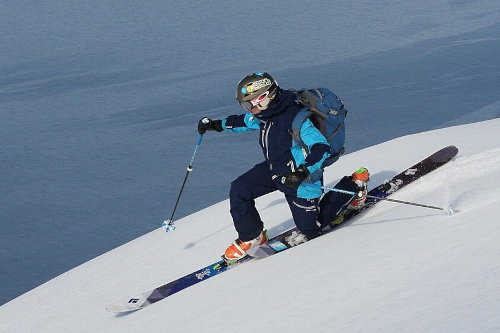
photo credit: Funcarver116 / Wikimedia Commons / CC0
Key Takeaways
- Telemark skiing combines elements of Nordic and alpine skiing, using a free-heel binding that enables a distinctive, flowing turn style.
- The discipline traces its roots to 19th-century Norway and has experienced a modern resurgence as both a resort and backcountry sport.
- Proper equipment selection, especially boots and bindings, plays a critical role in comfort, control, and learning progression.
- The telemark technique relies on balanced knee movement, steady upper-body posture, and rhythmic transitions between turns.
- Beyond physical fitness benefits, telemark skiing is known for its welcoming culture and emphasis on freedom and connection to the mountains.
John Cogswell is a chief market strategist at Baystate Wealth in North Reading, Massachusetts, where he has advised clients on portfolio construction, asset allocation, and market strategy since 2009. John Cogswell is a Chartered Financial Analyst charterholder with a background in international finance from Northeastern University, and his professional focus includes equities, fixed income, options, and alternative investments. Alongside his work in financial markets, he maintains an active interest in outdoor pursuits that require balance, discipline, and long-term skill development.
An avid skier who spends winter months exploring New England terrain, Cogswell’s appreciation for technical and endurance-based activities provides a natural context for examining telemark skiing. Telemark skiing blends uphill mobility with downhill control and emphasizes rhythm, balance, and adaptability across changing conditions. Understanding the fundamentals of this discipline offers insight into a distinctive skiing tradition that differs from both alpine and Nordic styles while remaining accessible to those willing to learn its core techniques.
An Introduction to Telemark Skiing
Telemark skiing sits in between Nordic trekking – a walking activity that uses specially designed poles to enhance natural movement – and downhill skiing (alpine skiing). Unlike other skiing types, the heel isn’t locked down. With the back of the boot free, skiers drop into a smooth, kneeling-style turn that feels more natural and less rigid. Thus, it offers skiing freedom across varied terrain, from flats to steep slopes. Its rhythmic, meditative style contrasts with alpine skiing, making it accessible and rewarding for both beginners and experienced skiers.
In the mid-1800s, Sondre Norheim, a Norwegian farmer and skilled craftsman, experimented with flexible bindings made from flexible birch wood and designed skis with a narrow waist, a shape called sidecut. His invention made controlled turning possible. While alpine skiing and its fixed-heel bindings took over most of the 20th century, telemark never disappeared. It re-emerged in the 1970s and 80s and has since grown into a global sport.
Essential telemark equipment includes specialized skis, boots, and bindings. Skis are typically lighter, wider, and more flexible than alpine skis to support turning. Telemark bindings keep the heel unattached, allowing it to lift. Modern bindings include the traditional 75mm “duckbill” system, a symmetrical New Telemark Norm (NTN) version, and lightweight tech-toe systems designed for the backcountry. Many modern skiers prefer NTN because they deliver power evenly to the ski edges, resulting in a more balanced feel. Modern tech-toe boots integrate specialized fittings for uphill efficiency.
Choosing the proper boots is crucial. Telemark boots must have a flexible instep to accommodate the signature kneeling motion. While expert riders may choose stiff boots for responsiveness, beginners benefit from mid-range flexibility. Additionally, traditional “duckbill” boots feature a large plastic lug. For backcountry touring, skiers use climbing skins or wax to travel efficiently uphill.
Learning the technique starts with a stance mirroring a controlled squat: one ski slides forward while the back foot rises slightly onto the toes. Instead of relying mainly on ankle movement, telemark skiing depends on alternating knee bends to control speed and direction. Keeping pressure balanced on both skis is crucial. Beginners often spread their legs too far apart, but staying compact makes turns smooth and stable.
The upper body should face downhill, calm and steady, while the legs do the work underneath. Good turns have a gentle up-and-down rhythm, using momentum and gravity to flow from one turn to the next. A common mistake is staying too low for too long, leading to awkward shuffling rather than clean turns. Committing fully to the drop and rise of the movement unlocks better edge control and confidence. With practice, skiers can progress to carving turns, jump turns, and more advanced techniques.
Physically, telemark skiing is demanding in a good way. The repeated lunges build strength in the quadriceps, hamstrings, and glutes, while also delivering a solid cardiovascular workout. Some believe the balanced movement can even support knee health by strengthening surrounding muscles. Because the movement is more intuitive and less rigid, it can feel less taxing on the joints when performed correctly.
Telemark skiing’s biggest draw is the culture. It is known for its relaxed, welcoming community and its deep respect for the mountains. Festivals, clubs, and local meetups are common, and advice is freely shared. For many, telemark skiing offers a sense of freedom and a calm they find more rewarding than traditional skiing.
Starting telemark skiing requires patience and stepping outside your comfort zone. Professional instruction, such as from the North American Telemark Organization, helps build proper technique early. Basic turns come quickly, but mastery takes seasons. Norway and select US regions offer ideal learning terrain, supported by local clubs.
FAQs
What makes telemark skiing different from alpine skiing?
Telemark skiing uses free-heel bindings that allow the heel to lift, creating a kneeling-style turn that feels more fluid and less rigid than alpine skiing.
Is telemark skiing suitable for beginners?
Yes, while it requires patience and practice, beginners can learn the basics with proper instruction and appropriately flexible equipment.
What equipment is required for telemark skiing?
Essential gear includes telemark-specific skis, boots with a flexible instep, and bindings that allow the heel to lift, with several modern systems available.
What physical benefits does telemark skiing provide?
The technique builds leg strength, improves balance, and delivers cardiovascular exercise through repeated, controlled lunging movements.
Why do many skiers choose telemark skiing over other styles?
Many are drawn to its rhythmic movement, adaptability to varied terrain, and the relaxed, community-oriented culture surrounding the sport.
About John Cogswell
John Cogswell is chief market strategist at Baystate Wealth in North Reading, Massachusetts, where he guides asset allocation and portfolio strategy across equities, fixed income, options, and alternative investments. A Chartered Financial Analyst charterholder, he earned his degree in international finance from Northeastern University and maintains membership in the Boston Analyst Society. Outside of his professional work, he enjoys skiing, golf, cooking, and exploring New England’s outdoor landscapes.