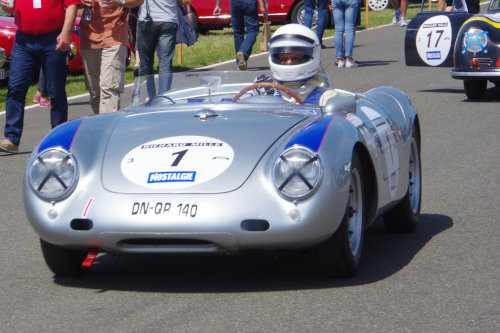
photo credit: Dave Hamster / Wikimedia Commons / CC BY 2.0
Key Takeaways
- The Porsche 550 Spyder was one of the first true purpose-built racing cars.
- Its lightweight design and aerodynamic focus helped it defeat much larger competitors.
- The advanced Type 547 four-cam engine doubled the power of earlier Porsche race cars.
- The 550 Spyder built a legendary racing record and earned the nickname “giant killer.”
- Its rarity, racing heritage, and association with James Dean have made it a prized collector’s car.
Gabriel Vadasz is a Phoenix, Arizona-based attorney and entrepreneur with experience spanning legal practice, finance, and business strategy. Over the course of his career, Gabriel Vadasz has advised clients on matters involving mergers and acquisitions, regulatory compliance, and complex transactions, while also leading consulting and venture initiatives designed to help organizations operate effectively in competitive environments. His professional background includes work in corporate law, trust and probate matters, and strategic business planning, providing a broad perspective on how innovation, risk, and performance intersect across industries.
Beyond his legal and advisory work, Gabriel Vadasz maintains an interest in automotive history and engineering as examples of how focused design decisions can redefine an entire field. That lens provides useful context for examining landmark developments such as Porsche’s 550 Spyder, a vehicle that marked a decisive shift toward purpose-built racing cars. The 550 Spyder illustrates how technical precision, lightweight construction, and competitive intent combined to establish a lasting legacy in motorsport history.
Porsche 550 Spyder and the Origins of Purpose-Built Racing Design
The Porsche Spyder is a classic car that has stood the test of time. Introduced in 1955, the 550 Spyder came about when Ferry Porsche and his engineers set about creating a better racing vehicle than the 356. Competitors were, for the first time, designing models specifically for competition in various racing classes.
The German manufacturer’s first-ever purpose-built racing car was engineered to compete in 1.1-liter and 1.5-liter classes and had aerodynamic efficiency and a lightweight aluminum build. The compact car featured a weight of only 1,112 pounds and had the agility to outmaneuver larger competitors on the track.
Another innovation was the Type 547 engine. The so-called Fuhrmann engine featured an air-cooled 1.5-liter flat-four boxer design. This increased power output twofold from the single-cam 356. The engine also featured dual overhead camshafts attached to each cylinder bank. With a four-camshaft design, complexity, precision, and performance expanded, and the engine offered an impressive 135 horsepower.
The results were immediate and compelling, with the third 550 Spyder prototype achieving victory in its racing debut at the Nürburgring Eifel Race in 1953. Across its production lifetime, the 550 Spyder competed in 370 races, attaining 75 class wins and 95 overall victories. Known as the “giant killer” for the way it regularly defeated larger displacement engine competitors such as Maserati, Jaguar, and Ferrari, it dominated circuits such as the Mille Miglia and Le Mans.
On September 30, 1955, the 550 Spyder became associated with tragedy, as actor James Dean was killed in the vehicle he knew as “Little Bastard” en route to a race held in Salinas, California. Today, this connection to the sudden loss of an emerging Hollywood star and generational icon has made the 550 the most popular model. Some collectors go so far as to create versions with the exact modifications, down to the silver paint, of the actor’s original. With only 90 of the car ever built, the first-generation, street-legal Spyder is one of the rarest and most expensive Porsche models.
The 550A, launched in 1956, offered a stiffer and lighter chassis, which allowed for advanced suspension systems. It also had a more aerodynamic contour, thanks to a tubular space frame design. In particular, the rear suspension eliminated unnecessary suspension movement and allowed for more aggressive cornering on race track curves.
In 2021, enthusiasts found an original model 550 Spyder in a storage container in a remote and rugged part of Orange County, California. A family called a bike show founder to tell him about many motorcycles their father had owned in storage. When the bike enthusiast visited, he found a pair of bikes hanging over the Spyder. The collector at first assumed it was a fiberglass replica. After some research, he determined that serial no. 550-0069 was completely authentic and in pristine condition.
The late owner had purchased the body, with no engine, for around $10,000 in today’s dollars and tracked down an original four cam engine (no. 0075) to put in it. After light driving, he had then put it in storage, where it experienced no wear for years.
The buyer, a Dutch collector, paid $4.5 million for the elusive vehicle. Its provenance is now well established, with original buyer Albert Hosking having painted it red and the racing number 118 emblazoned on doors and hood. First raced in December 1955 at Nassau Speed Week, the car achieved a number of podium finishes over a period of Porsche history that extended to the early 1960s.
FAQs
Why is the Porsche 550 Spyder considered a milestone in racing design?
The 550 Spyder was one of Porsche’s first cars built specifically for racing rather than adapted from a road model. Its lightweight construction, aerodynamic shape, and focused engineering set a new standard for purpose-built competition cars.
What made the Type 547 engine so special?
The Type 547, also known as the Fuhrmann engine, used a complex four-camshaft design that significantly increased performance. This engineering allowed the small, lightweight car to produce impressive power for its class and compete with much larger rivals.
How successful was the 550 Spyder in competition?
The 550 Spyder achieved dozens of class wins and many overall victories across hundreds of races. Its ability to beat larger and more powerful cars earned it the reputation of a “giant killer” on famous circuits like Le Mans and the Mille Miglia.
Why is the 550 Spyder associated with James Dean?
Actor James Dean was killed in a crash while driving his 550 Spyder, which he nicknamed “Little Bastard,” in 1955. This tragic event added to the car’s mystique and helped cement its place in popular culture and automotive history.
Why are original Porsche 550 Spyders so valuable today?
Only a small number of 550 Spyders were ever built, making them extremely rare. Their racing heritage, historical significance, and strong collector demand have pushed values into the multimillion-dollar range.
About Gabriel Vadasz
Gabriel Vadasz is an attorney and entrepreneur based in Phoenix, Arizona, with more than a decade of experience in legal, financial, and strategic advisory roles. He has led and advised organizations on mergers, compliance, and complex transactions, and is a founding member of a consulting and venture firm focused on tailored business solutions. Gabriel Vadasz holds a law degree from Arizona Summit Law School and a political science degree from Northern Arizona University.