Key Takeaways
- Sustainable business success is built through consistent, disciplined execution rather than dramatic transformations.
- The Flywheel Effect shows how small, repeated efforts compound into unstoppable momentum over time.
- Strong companies focus on systems, processes, and culture – not just charismatic leadership.
- The Doom Loop occurs when organizations repeatedly change direction without allowing strategies to mature.
- Long-term value creation depends on focus, credibility, and commitment to a clear strategic path.
Sean Unwin is a Sydney-based executive with extensive experience in financial leadership, capital structuring, and property development advisory. As managing director of FWTI, Sean Unwin works with investors across Australia and the United Arab Emirates, guiding equity and debt funding strategies, mergers and acquisitions, and feasibility assessments for large-scale development projects. His career has spanned senior executive roles including chief executive officer and chief financial officer positions, where he has overseen operational growth, market expansion, and complex financial negotiations.
Sean Unwin’s professional background includes leading consulting and advisory teams that supported regulated funds management, property acquisition, and cross-border investment initiatives. This experience aligns closely with management frameworks that emphasize disciplined execution, long-term strategy, and sustainable momentum. Jim Collins’ concepts of the Flywheel Effect and the Doom Loop offer a useful lens for understanding how organizations either compound success through consistency or undermine progress through repeated, unfocused change.
Jim Collins’ Flywheel Effect and the Risks of the Doom Loop
Jim Collins’ classic book “Good to Great: A Study of Management Strategy” begins with the proposition that “good is the enemy of great.” He postulates that this is actually why so few things are great. Good schools lead to academic complacency that prevents great schools from emerging. Those who have “good enough” lives generally settle for that and don’t seek to expand their horizons to the fullest extent.
Undertaking extensive research in the late 1990s, Collins identified 11 key “good-to-great” examples that bucked the tendency to settle for good enough. He then sought to understand why and how these specific organizations had separated themselves from the pack. Among the highest performers of the era were Circuit City, Gillette, Walgreens, Philip Morris, and Fannie Mae. He undertook deep analysis of each spanning areas such as technology, leadership, strategy, compensation, and corporate culture.
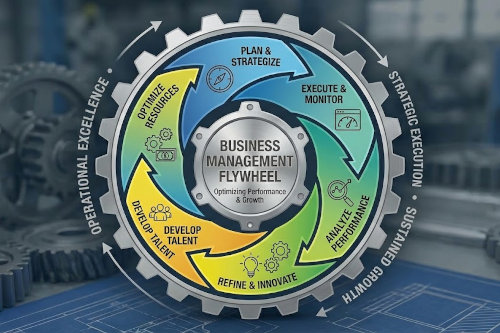
Collins’ key findings include that disciplines and systems, pursued over time, are more critical than the style of a single leader. He encapsulates this in the Flywheel Effect, wherein, “a huge, heavy metal flywheel” takes days of effort to inch forward and guide through a single revolution. However, with consistent, incremental effort, the flywheel gradually starts moving faster, to a point where its own weight propels it and it achieves unstoppable inertia.
An example of this incremental process is the pharmacy Walgreens which, for four decades, stood as an average company that tracked the general market. Suddenly, in 1975, the company took off and continued to climb consistently until the turn of the century, outpacing the market by a factor of 15. When asked in hindsight about what caused this change, corporate leaders were vague, simply noting that maintaining strong, customer responsive operations on a day-to-day basis ultimately paid off.
Collins also references an interview he conducted with Jim Herring, who oversaw the supermarket giant Kroger’s sustained expansion. Herring described avoiding all types of motivational stunts and change programs, instead focusing on achievable progress based on tangible evidence and careful planning. His team’s step-by-step focus on attaining well delineated goals and successful conclusions gave people confidence in actual results, rather than mere words. Accountability, authenticity, and credibility triumphed over hype and image.
The opposite of the Flywheel Effect is the Doom Loop, which occurs when a corporate body tries to effect change while lacking discipline. Starting down one pathway with great fanfare, they change course when headwinds appear and fail to achieve enough momentum to get the flywheel going. Poor results impact morale and employee retention, and the company enters a “death spiral.” This often involves multiple restructurings and ultimately takeover by a competitor.
One prominent example of a Doom Loop is Warner-Lambert, which set out to carve out a niche in the consumer-products sector in 1979. Failing that, it reversed course within a year and focused on growth in health care. In 1981 it shifted a third time to consumer goods and product diversification. Its final reversal occurred in 1987, when it decided it would compete in pharmaceuticals with Merck. When healthcare reform entered the horizon in the early 1990s, the company diversified into consumer brands again. These sudden changes cumulatively caused employee whiplash and consumer fatigue, and in 2000 Pfizer ultimately took over Warner-Lambert.
FAQs
What is Jim Collins’ Flywheel Effect?
The Flywheel Effect describes how sustained, consistent effort gradually builds momentum until progress becomes self-reinforcing. There is no single breakthrough moment – success compounds over time.
Why is consistency more important than dramatic change?
Consistent execution builds trust, systems, and results that accumulate over years. Frequent strategic shifts prevent organizations from ever building real momentum.
What is the Doom Loop in business?
The Doom Loop happens when companies repeatedly change strategy, leadership, or direction in response to short-term pressure. This destroys morale, weakens results, and prevents long-term progress.
What companies illustrate the Flywheel Effect?
Jim Collins highlights companies like Walgreens and Kroger, which achieved exceptional performance through decades of steady, disciplined improvement. Their success came from focus, not sudden reinvention.
How can leaders avoid falling into the Doom Loop?
Leaders must commit to a clear strategy and give it time to work instead of reacting to every setback. Discipline, patience, and measurable progress are the antidotes to strategic whiplash.
About Sean Unwin
Sean Unwin is the managing director of FWTI in Sydney, Australia, where he provides advisory services in capital funding, mergers and acquisitions, and property development. His background includes senior leadership roles in financial management, consulting, and real estate investment across Australia and the UAE. With experience spanning feasibility analysis, debt structuring, and cross-border investment strategy, Sean Unwin focuses on disciplined execution and long-term value creation.