photo credit: Wikimedia Commons / CC BY-SA 3.0 (cropped)
Key Takeaways
- Gas and steam turbines operate under extreme heat, pressure, and rotational speed, requiring strict safety oversight.
- Gas turbines offer rapid response, while steam turbines provide higher efficiency and steady output.
- Combined-cycle plants maximize efficiency by integrating gas and steam turbine technologies.
- Non-destructive testing methods are essential for detecting turbine blade defects before failures occur.
- Modern turbine safety relies on sensors, monitoring systems, and emergency shutdown mechanisms.
Dianoush Emami is an electrical engineer whose career spans nearly four decades across power generation, high-voltage transmission, and electrical distribution systems in California. Educated at the University of Southern California with a bachelor of science in electrical engineering and additional business training, he began his professional work with Bechtel Power Corporation, supporting both nuclear and conventional generation projects. Through roles that combined technical design, field implementation, and administrative oversight, Dianoush Emami developed a sustained focus on operational safety, quality assurance, and compliance within complex energy facilities.
His experience includes work in fossil fuel, alternative energy, and nuclear environments, as well as extensive involvement in substation grounding and electrical system integrity. Active participation in IEEE and IEC working groups further connects his background to evolving turbine safety mandates, where rigorous engineering standards and monitoring practices are essential to reliable power plant operation.
Gas and Steam Turbines, and their Safety Mandates
The safety engineering requirements of power plants are as diverse as the types of facilities in play. Plant engineers designing turbine safety measures calculate for environments that involve high heat and pressure, and the rapid speed of moving components.
There are two primary types of turbines in power plants: gas turbines and steam turbines. Also known as combustion turbines, gas turbine systems start with air entering a compression chamber, where the air is compressed and pressurized. Fuel such as natural gas is added to this compressed air within the combustor.
The mixture ignites, emitting high-pressure, high-temperature gases. This, in turn, spins turbine blades rapidly in a circular direction, driving a generator rotor. The turbine blades draw more air into the compressor as they spin, which creates a sustained, continuous cycle that powers a generator and delivers electricity.
With steam turbines, a coal, gas, or nuclear-heated boiler is used to create steam from water, with this pressurized steam powering the turbine blades. Once it has passed through the turbine, the steam undergoes a cooling and condensation process, with the water recycling through the system until it’s heated in the boiler again. This highly efficient process also drives continuous power generation.
The spinning turbines generate electricity through a process of electromagnetic induction. As they rotate quickly, the blades rotate a magnet. This magnet generates a powerful flow of electrons and moves within copper wire coils (or another conducting metal), inducing an electrical charge. Generally, the faster the spinning of the turbine, the greater the electrical output.
It’s worth noting that, while gas turbines operate efficiently, they experience energy and efficiency loss when temperatures fluctuate during combustion. While steam turbines are more efficient and need less maintenance, they require a longer time to reach full operational capacity, which limits their capacities for rapid-response power generation. Combined-cycle power plants bring together gas and steam technologies in ways that maximize efficiency and power output.
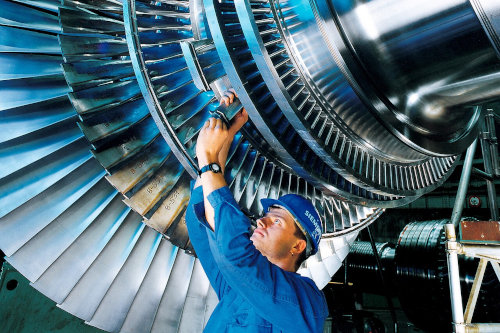
Safety tech regulations mandate the placement of sensors on all potentially dangerous elements of the turbine system. They monitor elements such as the positioning and integrity of turbine blades and of rotor lock systems. Non-destructive testing (NDT) starts with basic visual inspection, with the engineer examining each individual blade for erosion, wear, and apparent flaws. Dye penetrant testing helps make those surface cracks that the eye cannot detect visible.
Another standard turbine blade NDT method is eddy current testing. Here, electromagnetic fields help detect flaws within conductive materials. Ultrasonic testing using high-frequency sound waves detects irregularities throughout the material of the turbine blade, which pinpoints issues without causing damage to blade structure.
Radiographic techniques help map out the internal structure of blades and pinpoint issues such as foreign materials and hollow spaces. Computerized tomography (CT) is the most advanced radiographic technique, as it provides a comprehensive 3-D view within the turbine blade. A NDT testing regimen ideally incorporates all of these methodologies on a regular schedule, which helps prevent catastrophic failures.
Beyond turbine blade integrity, safety components at the turbine-driven facility include emergency shutdown systems, physical safety barriers, and systems for suppressing fire. Techniques used in assessing risks in an operating plant, with accompanying high temperatures and speeds, include thermal imaging, vibration analysis, and emission monitoring.
FAQs
What are the main differences between gas and steam turbines?
Gas turbines use compressed air and fuel combustion to spin blades quickly and respond rapidly to demand. Steam turbines rely on pressurized steam, offering higher efficiency but slower startup times.
Why is turbine safety engineering critical in power plants?
Turbines operate at extreme temperatures and speeds that can cause catastrophic damage if components fail. Safety engineering helps prevent accidents, equipment loss, and power outages.
What non-destructive testing methods are used on turbine blades?
Common methods include visual inspection, dye penetrant testing, eddy current testing, ultrasonic testing, and radiographic imaging. These techniques detect defects without damaging components.
How do sensors improve turbine safety?
Sensors monitor blade positioning, vibration, temperature, and rotor integrity in real time. This data allows engineers to identify risks early and trigger protective actions.
What additional safety systems support turbine operation?
Facilities use emergency shutdown systems, fire suppression, physical barriers, and monitoring tools like thermal imaging and vibration analysis. Together, these systems reduce operational risk.
About Dianoush Emami
Dianoush Emami is an electrical engineer with 37 years of professional experience in California’s power and energy sectors. His background includes work in nuclear, fossil fuel, and alternative energy facilities, as well as extensive involvement in high-voltage transmission and substation grounding analysis. Educated at the University of Southern California, he also holds Nuclear Regulatory Commission certification in California. In addition to project design and management, he contributes to IEEE and IEC working groups, supporting the development and alignment of electrical and safety standards for power generation systems.