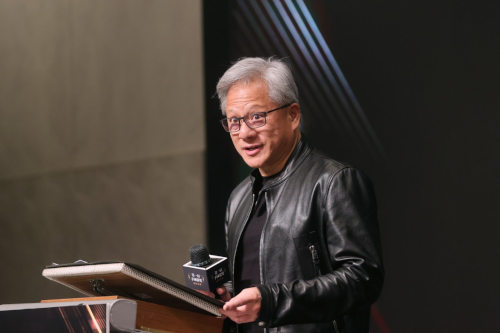
Jensen Huang of NVIDIA – photo credit: Wikimedia Commons / CC BY 2.0
Key Takeaways
- The strongest innovations focus on building systems, not just products or features.
- Purpose and ethics are increasingly central to scaling new technologies.
- Breakthroughs compound when discovery itself is systematized.
- Long-term thinking consistently outperforms short-term optimization.
- Execution, resilience, and discipline are as innovative as bold ideas.
Innovation isn’t a single breakthrough moment — it’s a discipline built over time. Across industries as different as artificial intelligence, biotech, e-commerce, and space exploration, the world’s most impactful innovators share common ways of thinking, building, and leading. These lessons from leaders and visionaries in innovation capture how transformative ideas move from curiosity to real-world impact — and why the best innovations endure long after the spotlight fades.
Lesson 1: Turn frustration into infrastructure
Shopify was born from a founder’s frustration with poor e-commerce tools, not from a grand ambition to dominate global commerce. Instead of patching a broken experience, Tobi Lütke rebuilt the entire system behind it, creating a platform that enabled millions of entrepreneurs to sell online with ease.
The deeper innovation was structural. By focusing on infrastructure rather than individual features, Shopify became a foundation others could build upon. The most enduring innovations often solve problems by redesigning the environment around them, not by offering temporary fixes.
– Tobi Lütke, Founder & CEO of Shopify
Lesson 2: Scale intelligence with purpose
Fei-Fei Li’s work in artificial intelligence consistently emphasizes that technological power must be paired with human values. Her leadership in human-centered AI reframes progress as intelligence that supports people, rather than systems optimized purely for efficiency or automation.
The lesson is clear: innovation without intention risks eroding trust. When values guide development, technology becomes more usable, more accepted, and more impactful. Purpose is not a constraint on innovation — it is what allows innovation to scale responsibly.
– Fei-Fei Li, AI Pioneer
Lesson 3: Build discovery systems, not one-off breakthroughs
Rather than chasing individual drug discoveries, Daphne Koller focused on reinventing how discoveries are made. By applying machine learning to biology, she transformed drug development into a repeatable, data-driven system that improves with each iteration.
This approach highlights a powerful principle: the greatest innovations often lie in building engines for discovery. When learning compounds over time, breakthroughs become inevitable outcomes rather than isolated events.
– Daphne Koller, AI & Biotech Leader
Lesson 4: Play the long game of intelligence
Demis Hassabis has consistently pursued deep understanding over short-term wins. From mastering complex games to advancing scientific research, his work reflects a commitment to foundational intelligence rather than surface-level applications.
True innovation often requires patience — a willingness to explore complexity without immediate rewards. Those who invest in depth create technologies that remain relevant long after trends shift.
– Demis Hassabis, Co-Founder & CEO of DeepMind
Lesson 5: Build platforms, not products
Jensen Huang transformed NVIDIA from a niche graphics company into the infrastructure layer of modern AI by focusing on platforms, not standalone products. While others optimized for short-term performance gains, Huang invested early in GPUs as a general-purpose computing engine and built CUDA to anchor developers to NVIDIA’s ecosystem.
The lesson is strategic patience. Platforms compound over time, turning every industry shift into a tailwind rather than a threat. Huang’s approach shows that the most powerful innovations aren’t always visible at first—they become indispensable precisely because everything else eventually depends on them.
– Jensen Huang, Founder & CEO of NVIDIA
Lesson 6: Redefine the constraints
Elon Musk approaches innovation by questioning assumptions others accept as fixed. Whether reducing the cost of rockets through reuse or rethinking how cars are designed and manufactured, he starts from first principles and rebuilds systems from the ground up. This allows his companies to move faster and tackle problems most incumbents avoid.
The lesson is simple but demanding: real innovation comes from redesigning the rules, not optimizing within them. By treating bold goals as non-negotiable constraints, Musk turns ambition into an engine for execution rather than a distant vision.
– Elon Musk, Founder & CEO of Tesla, SpaceX and more
Lesson 7: Treat failure as engineering feedback
Early versions of The Ocean Cleanup failed in visible and costly ways. Instead of abandoning the mission, Boyan Slat and his team treated each failure as a technical lesson, refining designs through real-world data.
Innovation at scale demands resilience. Progress comes not from avoiding failure, but from systematically learning from it and adapting faster than the problem evolves.
– Boyan Slat, Founder of The Ocean Cleanup
Lesson 8: Balance speed with responsibility
Sam Altman operates at the intersection of rapid technological advancement and societal consequence. His approach reflects the belief that innovation must move quickly — but never blindly.
Sustainable progress requires aligning velocity with responsibility. Innovators who acknowledge broader impact earn trust, legitimacy, and long-term influence.
– Sam Altman, CEO of OpenAI
Lesson 9: Reinvent through disciplined focus
Lisa Su led one of the most remarkable corporate turnarounds in modern technology by making hard, focused choices. Rather than chasing every opportunity, AMD concentrated on engineering excellence and long-term strategy.
Her story proves that innovation doesn’t always mean radical disruption. Sometimes, disciplined execution and clarity of direction are the most transformative forces.
Lesson 10: Execution is a form of innovation
While SpaceX is known for bold vision, Gwynne Shotwell turned ambition into reality by making execution reliable and repeatable. Her leadership transformed rocket launches from rare events into scalable operations.
Many innovations fail not because the idea is flawed, but because execution breaks down. Operational excellence is often the difference between visionary concepts and lasting impact.
– Gwynne Shotwell, President & COO of SpaceX
Final Words: Innovation Is a Practice, Not a Personality
What unites the world’s most effective innovators isn’t genius, charisma, or flawless execution — it’s how they think about progress. They build systems instead of chasing moments, treat failure as feedback, and balance ambition with responsibility. Most importantly, they recognize that innovation is not a single act of creativity, but a continuous discipline shaped by curiosity, patience, and execution.
As technology and industries evolve faster than ever, these lessons offer a grounded framework for building ideas that last. If you’re interested in exploring more stories, insights, and deep dives into how innovation is reshaping business and society, explore our latest innovation features at https://biz.bio/category/innovation/
FAQs
What defines true innovation today?
True innovation goes beyond novelty. It creates lasting value by reshaping systems, behaviors, or industries in ways that scale sustainably over time.
Why do many innovative ideas fail to gain traction?
Most failures stem from weak execution, misaligned incentives, or ignoring user behavior — not from a lack of creativity.
Is innovation only about technology?
No. Innovation can emerge from business models, processes, interfaces, leadership styles, and operational discipline.
How important is failure in innovation?
Failure is essential when treated as feedback. Iterative learning turns setbacks into data that improves future outcomes.
Can large organizations still innovate effectively?
Yes, but only when they combine focus, long-term thinking, and cultural openness to change — as demonstrated by several leaders in this list.