Key Takeaways
- Beginner martial arts classes are designed for adults with no prior experience and focus on fundamentals.
- Early sessions emphasize warm-ups, posture, balance, and controlled solo movement before partner drills.
- Most schools allow beginners to train in standard athletic clothing before committing to uniforms.
- Instructor pacing and structured progression help new students build confidence without feeling rushed.
- Consistent attendance and repetition drive progress more than intensity or prior athletic ability.
Baron Nadder Haghighi-Brookheim is an experienced business executive whose career spans international trade, technology development, and safety innovation. As the executive founder of FireIce Solutions, he has led the development and testing of FireIce, a firefighting gel designed to improve the effectiveness of water for emergency response. Baron Nadder Haghighi-Brookheim has also served for decades as the chief executive officer of Michael Technologies Group International, an importing and exporting company that has delivered thousands of products to nearly 100 countries. He holds a doctoral degree in international business and banking from the International Institute of Business Management in Geneva, Switzerland.
Beyond his professional leadership roles, Baron Nadder Haghighi-Brookheim maintains a strong interest in personal discipline, physical conditioning, and structured routines that support long-term performance. These values align closely with martial arts training, which emphasizes consistency, controlled progression, and foundational skills.
For adults considering a martial arts class for the first time, understanding how beginner programs are structured can help reduce uncertainty and set realistic expectations for training and personal development.
Getting Started with a Martial Arts Class as a Beginner
Adults sign up for a martial arts class to build fitness, improve concentration, or add a disciplined routine to their week. Beginner programs introduce the fundamentals to adults with little or no prior experience and do not require a competitive sports background. Instructors teach basics in a measured sequence and help new students understand how the class runs before drills become more demanding.
Beginner classes begin with a short warm-up that blends light cardio, dynamic stretching, and basic movement drills. Students might jog lightly, practice simple stretches, and work through basic conditioning or mobility patterns. These activities prepare students physically for class while also introducing how instructors organize movement in martial arts training.
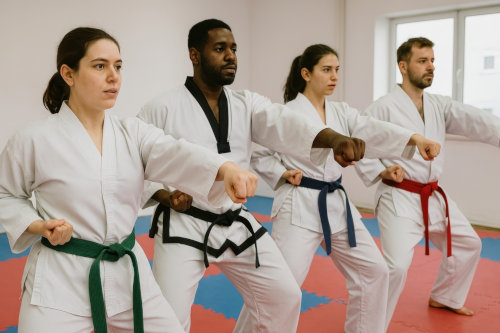
After warming up, instructors guide students through foundational solo drills that emphasize posture, balance, and controlled movement. These drills may include holding basic stances, shifting weight, or stepping forward and backward with purpose. These drills help students build body awareness and stability, which instructors rely on when introducing later techniques.
Once students are comfortable with basic movement, schools introduce technical practice in a defined sequence. Beginners first rehearse techniques, such as punches or blocks, without contact, often in the air, focusing on form and alignment. As readiness improves, instructors may add controlled partner drills and supervise them closely, so partners practice with control and focus on timing and positioning rather than force.
Before students commit to uniforms, testing, or long-term enrollment, many schools keep early expectations simple and explain requirements as students continue. Beginners usually train in standard athletic clothing, and schools set different points for when students start wearing a uniform or add protective gear. In early training, instructors often emphasize fundamentals and explain how progression works in that program, including what students need to demonstrate as they move forward.
Instructors manage class pace and difficulty throughout each session. They correct form, slow drills when needed, and remind students to work at an appropriate pace when fatigue affects technique. These adjustments reflect the instructor’s responsibility to pace instruction appropriately, ensuring that beginners can continue learning without feeling rushed.
Peer interaction also shapes the beginner experience. Instructors set expectations, and classmates support each other through structured partner work, which helps new students understand expectations and feel more comfortable during drills. Clear cues from instructors and respectful training partners reduce the likelihood that uncertainty or discomfort will lead someone to stop attending.
After several weeks of consistent attendance, beginners may notice better coordination and balance during drills and increased stamina during class. Some students also report sharper attention during practice and a clearer sense of routine from attending scheduled sessions. Beginners build progress through steady repetition and regular attendance, not from trying to “go hard” in one session.
When choosing a program, adults benefit from observing a class and asking how instructors group, pair, and progress beginners. Watching how instructors explain drills and how students interact helps adults evaluate whether the school prioritizes clarity and consistency. Programs that clearly communicate expectations and progression can help new students stay engaged and return regularly.
Some beginners eventually join sparring classes, where students practice controlled contact under supervision, or try other styles, but most progress simply by returning each week and building comfort with repetition. Early success comes from controllable habits: arrive a few minutes early, follow instructions closely, and pace effort so technique stays clean. When training feels routine, beginners can decide whether to add sparring or explore another style based on the skills they want to build next.
FAQs
Do you need prior experience to start a martial arts class?
No prior experience is required for beginner martial arts classes. Programs are structured to introduce fundamentals gradually for adults with little or no background.
What happens in a typical beginner martial arts class?
Classes usually begin with a warm-up, followed by basic movement drills and foundational techniques practiced without contact. As students progress, instructors may introduce light, controlled partner work.
What should beginners wear to their first class?
Most schools allow beginners to train in regular athletic clothing at first. Uniforms and protective gear are typically introduced later once students decide to continue.
How fast do beginners progress in martial arts?
Progress depends on consistency rather than intensity. Regular attendance and repetition help beginners improve coordination, balance, and stamina over time.
How can adults choose the right martial arts program?
Observing a class helps evaluate how instructors explain drills and pace beginners. Programs with clear structure and supportive class culture tend to keep new students engaged.
About Baron Nadder Haghighi-Brookheim
Baron Nadder Haghighi-Brookheim is a business executive and innovator with decades of experience in international trade, safety technology, and operations leadership. He is the executive founder of FireIce Solutions and the chief executive officer of Michael Technologies Group International. Holding a doctoral degree in international business and banking, he has overseen global manufacturing, testing, and distribution initiatives while also supporting charitable causes, including pediatric cancer fundraising.