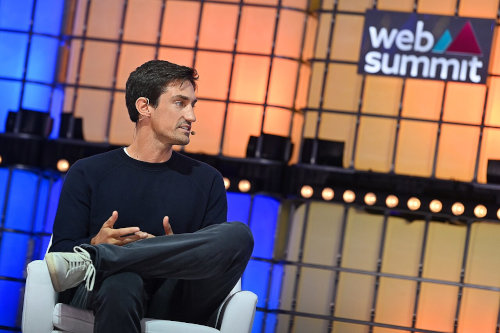
Guillaume Pousaz, Founder and CEO of Checkout.com
photo credit: Web Summit / Wikimedia Commons / CC BY 2.0
Key Takeaways
- Obsession with real problems beats chasing novelty or trends.
- Platforms and systems compound faster than standalone products.
- Trust, culture, and authenticity scale as powerfully as technology.
- Infrastructure and leverage often outperform visibility and hype.
- The best founders build for where the market is going – not where it is.
The most valuable entrepreneurship lessons don’t come from playbooks or trend reports. They come from founders who made asymmetric bets before the market caught up – often while being misunderstood, underestimated, or outright dismissed.
Forward-looking founders share one defining trait: they build for what the world is becoming, not what it currently rewards. Their companies may operate in different industries – hardware, software, media, biotech, or consumer brands – but the lessons they leave behind are strikingly consistent.
Here are ten entrepreneurship lessons drawn from ten founders who didn’t just start companies, but reshaped categories.
1. Obsession Beats Originality – James Dyson, Founder of Dyson Ltd.
James Dyson didn’t invent the vacuum cleaner. He obsessed over why it failed.
After discovering that traditional vacuums lost suction as bags clogged, Dyson spent years iterating – building over 5,000 prototypes – before arriving at a bagless, cyclone-based design. The lesson wasn’t novelty; it was relentless dissatisfaction with mediocrity.
Entrepreneurship lesson: Breakthroughs often come from caring more about a problem than anyone else is willing to. Obsession compounds.
2. Platforms Outlast Products – Zhang Yiming, Founder of ByteDance
Zhang Yiming didn’t set out to build a viral app. He built an algorithmic content engine that learned faster than human editors ever could.
That insight powered ByteDance’s ecosystem, enabling products like TikTok to scale globally with unprecedented speed. The platform – the recommendation system – mattered more than any single app.
Entrepreneurship lesson: Products age. Platforms evolve. Founders who build adaptive systems win longer games.
3. Culture Is a Product Feature – Stewart Butterfield, Co-founder of Slack
Slack succeeded not because of superior features, but because it felt humane. Stewart Butterfield treated workplace communication as an emotional experience – reducing friction, confusion, and cognitive overload.
Internally, he applied the same philosophy to company culture, designing it deliberately rather than letting it emerge by accident.
Entrepreneurship lesson: Culture isn’t internal overhead. It’s part of what customers feel – directly or indirectly.
4. Trust Is the Ultimate Infrastructure – Michelle Zatlyn, Co-founder, President, and COO of Cloudflare
Cloudflare operates where failure is unacceptable: internet security and performance. Michelle Zatlyn helped scale trust across millions of customers by prioritizing reliability, transparency, and long-term thinking over short-term monetization.
In infrastructure businesses, reputation compounds faster than revenue.
Entrepreneurship lesson: If your product sits in the critical path, trust becomes your most defensible moat.
5. Control the Pipes, Not Just the Brand – Guillaume Pousaz, Founder and CEO of Checkout.com
Guillaume Pousaz didn’t chase visibility. He chased plumbing.
By building deep, reliable payment infrastructure for global enterprises, Checkout.com embedded itself into mission-critical workflows – where switching costs are high and loyalty is earned quietly.
Entrepreneurship lesson: The less glamorous your role in the value chain, the more durable your leverage can become.
6. Authenticity Scales Better Than Marketing – Jessica Alba, Co-founder of The Honest Company
Jessica Alba didn’t build The Honest Company by outspending incumbents. She built it by aligning personal values – safety, transparency, trust – with consumer frustration.
Customers didn’t just buy products; they bought belief.
Entrepreneurship lesson: Authenticity isn’t a brand tactic. It’s a scaling strategy when trust is scarce.
7. Community Is a Growth Engine – Rihanna, Founder of Fenty Beauty
Rihanna‘s business success with Fenty came from understanding inclusion before it was fashionable. She didn’t market to an audience – she built with them.
By listening to underserved consumers, Fenty turned community into distribution.
Entrepreneurship lesson: When customers feel seen, they market your product for you.
8. Data Should Empower, Not Intimidate – Anne Wojcicki, Founder and CEO of 23andMe
Anne Wojcicki entered a sensitive industry – genetics – by reframing data ownership. Instead of positioning consumers as passive subjects, she made them participants in their own health narratives.
The result wasn’t just a product, but a shift in how people relate to personal data.
Entrepreneurship lesson: Data-driven businesses win when users feel informed, not exposed.
9. Build Confidence Before Skills – Reshma Saujani, Founder of Girls Who Code
Reshma Saujani recognized a hidden barrier to entrepreneurship: confidence. Many people – especially women – self-select out of opportunity long before skill becomes the issue.
Girls Who Code focused as much on mindset as on programming.
Entrepreneurship lesson: The biggest bottleneck to innovation is often psychological, not technical.
10. Leverage Is More Important Than Hustle – Shaquille O’Neal, Founder of Big Chicken, etc.
Shaquille O’Neal didn’t treat entrepreneurship as a second career – he treated it as portfolio construction. By investing early in scalable brands and focusing on partnerships over operations, he multiplied impact without burning time.
Entrepreneurship lesson: Hustle has limits. Leverage doesn’t.
The Common Thread: Thinking One Step Ahead
What unites these founders isn’t industry, background, or personality. It’s temporal advantage – the ability to see around corners:
- Dyson saw engineering frustration where others saw appliances
- Zhang saw algorithms where others saw content
- Zatlyn saw trust as infrastructure
- Rihanna saw inclusion as market expansion
They didn’t wait for permission. They built for a future that didn’t yet have a name.
FAQs
1. What defines a forward-looking founder?
They build for future behaviors and unmet needs rather than current demand.
2. Are these lessons industry-specific?
No – these principles apply across consumer, enterprise, biotech, and creative industries.
3. Do founders need technical backgrounds to think forward?
Not necessarily; insight, empathy, and systems thinking matter more than credentials.
4. Is brand as important as product today?
In crowded markets, brand trust and authenticity often determine adoption speed.
5. Can these lessons apply to small businesses?
Yes – thinking long-term, building trust, and creating leverage benefit businesses of any size.
Final Thought
Entrepreneurship isn’t about predicting the future perfectly. It’s about preparing for it earlier than others.
The founders above didn’t win because they were louder, faster, or luckier. They won because they made decisions that only made sense later – and had the conviction to act before the proof arrived.
That, more than any tactic, is the enduring advantage of forward-looking entrepreneurship.