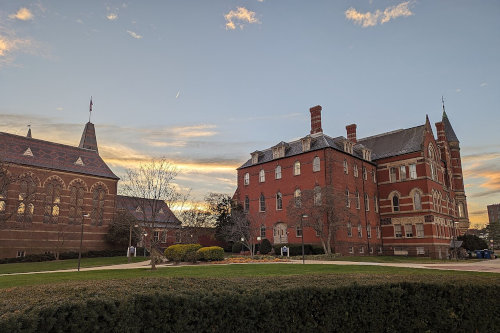
photo credit: Sdkb / Wikimedia Commons / CC BY-SA 4.0
Key Takeaways
- Gallaudet University began in 1856 as a small school for deaf and blind students in Washington, D.C.
- Amos Kendall’s land donation and congressional incorporation established the institution’s legal and physical foundation.
- Edward Miner Gallaudet expanded the school’s mission and led its transition into a degree-granting college in 1864.
- Presidential signatures on diplomas became a lasting tradition beginning with Ulysses S. Grant.
- The institution evolved into a federally supported center for deaf education, later renamed Gallaudet College in 1894.
Joshua Gallaudet is a finance and technology executive with more than a decade of experience in investment banking, consulting, and alternative asset management. A graduate of Trinity College with a degree in American history, Joshua Gallaudet later earned his MBA from Vanderbilt University, concentrating on accounting and corporate finance. His professional background includes roles at UBS AG, Class Action Refund LLC, Alvarez and Marsal, and PIMCO, where he has led reporting transformation initiatives and integrated data architecture across asset classes.
Beyond his work in finance, Joshua Gallaudet maintains a personal interest in deaf education, inspired by his great-great-grandfather, Edward Miner Gallaudet, the founder of Gallaudet University. This historical connection provides meaningful context for examining the institution’s origins and early development.
The Founding and Early Establishment of Gallaudet University
Located in Washington, D.C., Gallaudet University traces its origins to the mid-19th century, when federal involvement, private philanthropy, and emerging approaches to deaf education converged. The institution began as a modest effort to provide schooling and housing for a small group of deaf and blind children, but it gradually developed into a federally chartered college with a distinct educational mission. Its founding and early establishment were shaped by the actions of several individuals and by legislative decisions that formalized its role in American higher education.
The initial foundation was laid in 1856 by Amos Kendall, a former journalist and federal official who had served as Postmaster General under Presidents Andrew Jackson and Martin Van Buren. After being asked to contribute to a proposed school for deaf and blind children, Kendall became directly involved when he observed the conditions in which the students were living. He petitioned a local court to make the children his wards and donated two acres of his Kendall Green estate in northeast Washington for the construction of facilities to house and educate 12 deaf and six blind students. This donation provided the physical base upon which the institution would develop.
In 1857, Kendall took the additional step of securing congressional incorporation for the school. Congress formally established it as the Columbia Institution for the Instruction of the Deaf and Dumb and Blind, giving it a legal status and a national profile. Edward Miner Gallaudet was named superintendent of the new institution. His appointment reflected both continuity and experience in deaf education, as he was the son of Thomas Hopkins Gallaudet, who had founded the first permanent school for deaf children in the United States in Hartford, Connecticut, in 1817.
Under Edward Miner Gallaudet’s leadership, the institution expanded its educational scope. A significant milestone occurred in 1864, when Congress authorized the Columbia Institution to confer college degrees. President Abraham Lincoln signed the enabling legislation into law, formally establishing the collegiate component of the school. Gallaudet was named president of the institution, which at that time enrolled eight college students. This authorization marked the transition from a primary and secondary school into a degree-granting institution of higher education.
The early years of the college were characterized by gradual institutional consolidation. In 1869, Gallaudet presided over the first commencement ceremony, at which three students completed the full course of study and received diplomas. The diplomas were signed by President Ulysses S. Grant, establishing a tradition that continues, with the diplomas of all graduates bearing the signature of the sitting U.S. president. That same year, following Amos Kendall’s death, the remaining acreage of his estate was sold to the institution, further securing its physical presence in Washington.
As the 19th century progressed, the institution’s identity became more clearly defined. In 1894, the college portion was renamed Gallaudet College in honor of Thomas Hopkins Gallaudet, acknowledging his foundational role in American deaf education. This change reflected both institutional maturity and a desire to link the college’s mission to a recognized educational legacy. Through these early developments, the school established itself as a federally supported center for deaf education, laying the groundwork for its later expansion and eventual designation as Gallaudet University.
From its beginnings as a small residential school to its establishment as a congressionally authorized college, Gallaudet’s founding illustrates how targeted philanthropy, legislative action, and educational leadership combined to create a lasting national institution.
FAQs
Who is Joshua Gallaudet?
Joshua Gallaudet is a finance and technology executive with experience in investment banking and asset management. He maintains a personal interest in deaf education due to his family connection to Edward Miner Gallaudet, the founder of Gallaudet University.
How was Gallaudet University founded?
Gallaudet University began in 1856 when Amos Kendall donated land in Washington, D.C., to establish a school for deaf and blind children. Congress formally incorporated the institution in 1857 as the Columbia Institution for the Instruction of the Deaf and Dumb and Blind.
What role did Edward Miner Gallaudet play in the institution’s development?
Edward Miner Gallaudet served as superintendent and later president, guiding the school’s expansion into higher education. In 1864, he secured congressional authorization for the institution to grant college degrees, marking its transition into a collegiate institution.
Why are presidential signatures significant at Gallaudet?
The tradition began in 1869 when diplomas were signed by President Ulysses S. Grant. Since then, all graduates’ diplomas have borne the signature of the sitting U.S. president, symbolizing the university’s federal charter.
When did the institution become known as Gallaudet College?
In 1894, the college division was renamed Gallaudet College in honor of Thomas Hopkins Gallaudet. This change recognized his foundational role in American deaf education and reinforced the institution’s historical identity.
About Joshua Gallaudet
Joshua Gallaudet is a financial professional and consultant at PIMCO with experience in investment banking, data analysis, and alternative asset management. He holds a bachelor of arts in American history from Trinity College and an MBA from Vanderbilt University. His career includes leadership roles at UBS and Alvarez and Marsal, where he managed reporting frameworks and restructuring strategies. He maintains a personal interest in deaf education through his family’s historical connection to Gallaudet University.