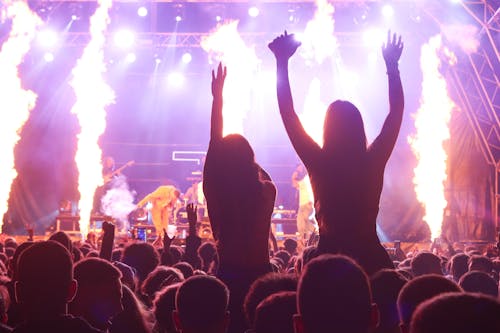
photo credit: alexandreeliasfotografia elias / Pexels
Key Takeaways
- Live entertainment continues to grow rapidly despite the dominance of digital platforms and streaming services.
- Shared in-person experiences create emotional and neurological engagement that screens cannot fully replicate.
- Concerts and festivals provide audiences with rare opportunities for focused attention and lasting memories.
- Consumers increasingly prioritize spending on experiences over material goods, even during economic uncertainty.
- Live events remain important cultural gathering spaces that foster connection, community, and collective identity.
Based in Southern California, Alec Celestin is a freelance creator and international tour manager whose work sits at the intersection of digital media and live entertainment. Alec Celestin has collaborated with artists, promoters, and global brands, delivering content strategies and managing tours that span multiple countries and audiences. Through his company, Fhotos n’ Frens, he provides end-to-end services including video production, social media, and promotional campaigns. His background includes roles at Universal Music Group, Flighthouse, and Afterparty, where he contributed to large-scale marketing initiatives and audience growth.
With experience both behind the scenes and as a performing DJ, his perspective reflects a direct understanding of how digital reach and live experiences complement each other in today’s evolving entertainment landscape.
Why Live Experiences Still Matter in a Digital-First World
The rapid growth of digital platforms has transformed how people consume music, entertainment, and culture. Streaming, social media, and virtual events have made content more accessible than ever. Yet live experiences – concerts, club events, global festivals – aren’t declining. They’re growing faster than most digital formats, which suggests in-person experiences fulfill something technology simply cannot replicate.
The data makes this hard to argue with. Live Nation posted $22.7 billion in revenue in 2023, a 36% jump from 2022, then followed it with a record $23.16 billion in 2024 (Billboard, Live Nation Earnings Reports). Concert attendance hit 151 million fans across 50,000+ events in 2024, up from 121 million in 2022 – which was already 24% above pre-pandemic 2019.
Meanwhile, streaming growth has decelerated sharply. The IFPI Global Music Report 2025 shows global streaming revenue growth slowing from 11.5% in 2022 to 10.3% in 2023 to just 6.2% in 2024. In the US specifically, streaming revenue grew only 3.6% (Music Business Worldwide). Live music revenue grew 25% in 2023 alone (Statista) and has now surpassed streaming in absolute terms – $33 billion for live versus $20.4 billion for streaming globally.
Pollstar’s Top 100 tour grosses jumped from $6.28 billion in 2022 to $9.17 billion in 2023 to $9.5 billion in 2024, a record. Even in 2025 at $8.9 billion, the Top 100 gross sits 60.8% above 2019. The experience economy is now valued at $778.7 billion globally and projected to hit $1.5 trillion by 2032 (WiseGuy Reports / Fortune).
One reason live experiences hold this power is the intensity of shared energy. In a concert or club setting, the audience isn’t passively consuming – they’re participating. The collective response of a crowd creates a feedback loop between performer and audience that a screen can’t reproduce.
Neuroscience backs this up. A 2024 study in PNAS (Fruhholz et al., University of Zurich) found that live music stimulates significantly higher amygdala activity than recorded music and identified “emotional entrainment” – listeners’ brains synchronizing with live performance in real-time through a neural network that doesn’t activate with recordings.
A 2026 randomized controlled study from the University of Groningen (Scientific Reports, n=130) found live concert attendees reported greater emotional response, higher arousal, and significantly different heart rate patterns compared to livestream viewers. This isn’t subjective – it’s measurable. Taylor Swift’s Eras Tour grossed $2.08 billion across 149 dates, the first tour to pass $2 billion (Pollstar). Coldplay’s Music of the Spheres sold 13.1 million tickets, the most ever for a single tour, at $1.52 billion (Billboard).
These numbers reflect a fundamental demand for shared physical experience at scale.
Live events also offer something increasingly rare: undivided attention. Digital platforms are built for multitasking, scrolling, and algorithmic consumption. A live event demands presence. That difference matters for how deeply experiences register.
Studies in Frontiers in Psychology (2021) show active engagement activates the prefrontal cortex, hippocampus, and temporal lobe – passive screen consumption does not. Research in ScienceDirect (2022) found that divided attention during encoding, the default state of digital multitasking, prevents conscious memory formation. A JAMA Pediatrics study (Cincinnati Children’s Hospital, 2019) linked higher digital media use with lower cortical thickness in memory and attention regions.
On the other side, a Goldsmiths University study found live concert attendees reported a 21% increase in well-being after just 20 minutes, with self-worth up 25%, closeness to others up 25%, and mental stimulation up 75%. In a world saturated with content, the experiences that demand full attention leave the deepest imprint.
Authenticity is another factor. Digital content is curated, edited, optimized for metrics. Live experiences are inherently unpredictable – technical imperfections, crowd reactions, real-time decisions all contribute to something audiences increasingly seek. No two events are the same. Glastonbury 2024 sold 210,000 tickets in under an hour. EDC Las Vegas 2023 drew 525,000 attendees over three nights with camping passes up 25%. Lollapalooza Chicago 2023 hit a record 400,000 including a 100,000 single-day high. These audiences are choosing the unscripted and unrepeatable over the polished and on-demand.
Consumer spending confirms this isn’t just sentiment – it’s economic behavior. Eventbrite’s 2023 research found 58% of US consumers now prioritize experiences over goods, with millennials at 61%. Deloitte’s 2024 Gen Z and Millennial Survey shows younger generations allocating 29% of income to travel versus 25-26% for older cohorts. Even in a tightening economy, McKinsey’s State of the Consumer 2025 found that while 75% of consumers traded down somewhere, 39% still intended to splurge – particularly on experiences.
Concert ticket prices have risen 43.89% in North America from 2019 to 2024, nearly double the 23.3% general inflation rate (Apollo Academy). Average Top 100 ticket prices climbed from $91.86 to $135.88. Yet attendance keeps breaking records. People are paying more and showing up in greater numbers.
Live events also serve as cultural anchors in a fragmented media landscape. Digital platforms personalize everything, which limits shared moments. Concerts, festivals, and major events bring diverse audiences together in a single place and time. The European Commission (2024) found cultural participation has a “clear and positive impact on civic engagement, democracy and social cohesion.” The Belong Network’s “Power of Events” report (2024) describes live events as spaces for “dialogue, community gathering, sharing and celebration” that build social capital across backgrounds and ages.
These moments create collective memories and shape culture in ways isolated digital consumption cannot.
Sources cited: IFPI Global Music Report 2025, Live Nation Earnings (2022-2024), Pollstar Year-End Reports (2022-2025), Statista, Billboard, Music Business Worldwide, WiseGuy Reports, Fortune, University of Zurich / PNAS (Fruhholz et al., 2024), University of Groningen / Scientific Reports (2026), Goldsmiths University of London / O2 (Fagan, 2018), Frontiers in Psychology (2021), ScienceDirect (2022), JAMA Pediatrics / Cincinnati Children’s Hospital (2019), Eventbrite (2023), Deloitte Gen Z and Millennial Survey (2024), McKinsey State of the Consumer (2025), Apollo Academy (2024), European Commission (2024), Belong Network (2024).
FAQs
Why are live experiences still popular in a digital-first world?
Live experiences provide emotional energy, social connection, and physical presence that digital content cannot fully reproduce. Concerts, festivals, and events create shared memories and immersive engagement that audiences continue to value.
How does live entertainment compare to streaming growth?
While streaming growth has slowed in recent years, live entertainment revenue and attendance continue to break records globally. Major tours and festivals consistently attract millions of attendees despite rising ticket prices.
What makes live events emotionally impactful?
Research suggests live music and in-person events stimulate stronger emotional and neurological responses than recorded or streamed content. Audience participation and crowd interaction create a unique shared experience.
Why are younger generations spending more on experiences?
Many younger consumers prioritize experiences because they value connection, authenticity, and memorable moments over material purchases. Live events also offer opportunities for social interaction and personal expression.
How do live events contribute to culture and community?
Live events bring people together in shared physical spaces, creating collective experiences that strengthen social bonds and cultural identity. They serve as important gathering points in an increasingly personalized digital landscape.
About Alec Celestin
Alec Celestin is a Southern California-based freelance creator and international tour manager. He founded Fhotos n’ Frens, providing content creation and promotional services for artists and influencers, generating significant global reach. His experience includes roles with Universal Music Group, Flighthouse, and Afterparty, where he supported marketing and brand initiatives. He has managed global tours for electronic artists such as Sevenn and has a background in business studies from Arizona State University, where he graduated summa cum laude.