photo credit: CC0
Key Takeaways
- EMTs provide critical prehospital care, stabilizing patients before they reach a hospital.
- The role requires medical knowledge, physical capability, emotional resilience, and strong communication skills.
- EMTs and paramedics perform different levels of emergency care based on their training and scope of practice.
- Becoming an EMT requires formal education, practical training, certification, and state-specific licensing requirements.
- Todd Belok’s experience as both an EMT and emergency physician provides a firsthand perspective on the importance of prehospital emergency care.
Todd Belok, DO, is an emergency medicine physician who currently practices at Central Maine Medical Center in Lewiston, Maine, delivering care to patients of all ages in a high-acuity setting. He also serves as an emergency physician with the U.S. Army Reserve’s 865th Field Hospital, deploying to Iraq in 2025 in support of Operation Inherent Resolve and earning the Army Commendation Medal with C Device. Belok concurrently works as a mental health technician at Temple University Hospital’s Episcopal Campus and previously served as a patient care technician, an emergency medical technician with the Capitol Heights Volunteer Fire Department, and a psychiatric technician.
He holds a doctor of osteopathic medicine from Touro College and a master’s degree from Drexel University, and completed his emergency medicine residency at University of Illinois Health. That frontline experience as an EMT and emergency physician grounds his perspective on the role emergency medical technicians play in stabilizing patients before they reach a hospital.
An emergency medical technician (EMT) is a first responder who provides immediate medical care at the scene of an emergency to stabilize a patient before a doctor arrives or the patient reaches the hospital. They receive 911 dispatches to respond to sudden injuries, illnesses, and trauma. EMTs provide comfort to people in vulnerable and potentially frightening situations.
EMTs differ from paramedics. While EMTs and paramedics both provide essential care outside a hospital, EMTs focus on basic treatments that do not require piercing the skin. Conversely, paramedics undergo more training to perform invasive interventions like starting intravenous lines. These advanced practitioners also administer a broader range of medications and use complex airway equipment to stabilize patients.
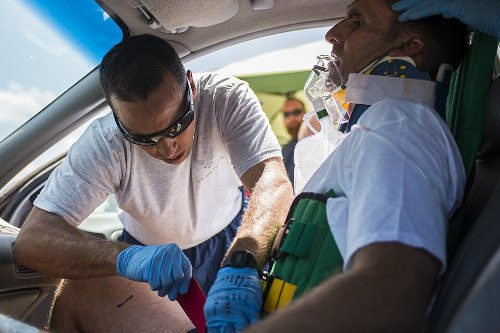
An EMT’s daily operation follows a sequence of patient assessment, medical treatment, and formal reporting. After arriving at a site of emergency, they must first evaluate a person’s physical state to set care priorities. They stabilize patients by performing chest compressions, managing airway paths, and stopping heavy external bleeding. They also offer oxygen delivery and immobilize fractured bones.
Importantly, an EMT must write down every step they take on-site to provide physicians with an accurate history of the incident. Clear data sharing with other clinicians and rescue personnel ensures successful field medicine. While transporting a patient in an ambulance, EMTs track vital signs and prepare the patient for entry into a medical facility. After completing a call, EMT staff must disinfect their equipment and replenish supplies to ensure they are ready for new emergencies.
To thrive as an EMT, a person requires a blend of mental fortitude and physical capability. Individuals must remain focused while making quick choices in unpredictable settings. Additionally, they must be strong enough to carry patients and operate in difficult outdoor conditions. Furthermore, EMT’s need to be compassionate and empathetic as they assist people dealing with intense fear or bodily pain. They should also have strong listening skills. This helps them collect medical facts accurately. Additionally, they should be able to soothe and reassure relatives and curious bystanders. Moreover, managing stress enables them to solve urgent problems when every second counts.
The path to becoming an EMT begins with earning a high school diploma or another equivalent qualification. Before enrolling in a formal EMT training program, candidates must first hold a valid cardiopulmonary resuscitation (CPR) certificate. Approved EMT courses usually take between 120 and 150 hours of instruction. Training combines classroom lectures with hands-on field experience, often placing students alongside ambulance crews to observe real emergency responses firsthand.
To become certified, candidates must pass two national exams testing both knowledge and hands-on skills. The first is a computer-based exam that checks a person’s understanding of injuries, breathing, and heart-related emergencies. The second exam, a practical skills test, requires students to demonstrate life-saving techniques through simulated patient situations. Once they pass these tests, candidates must apply for a state license and may need additional training to operate emergency vehicles legally. Many states also require ongoing recertification to help EMTs maintain high professional standards over time.
Because the national population is growing older, disasters continue to strike, and public health needs are expanding, there are strong employment prospects in this sector. Although the duties often require EMTs to work 12-, 18-, or 24-hour shifts, the career provides significant job security, with a median annual salary of about $41,340 as of May 2024. Many use this role as a stepping stone to advanced healthcare or leadership positions. It offers lasting fulfillment through helping communities during disasters and other crises, making EMTs an essential safety net.
FAQs
What does an emergency medical technician do?
An EMT responds to emergencies, assesses patients, provides basic emergency medical treatment, and transports patients when necessary. Their goal is to stabilize patients and maintain their condition until they can receive more advanced medical care.
What is the difference between an EMT and a paramedic?
EMTs generally provide basic emergency medical care, while paramedics receive additional training that allows them to perform more advanced interventions. Paramedics can typically administer a broader range of medications and perform procedures that are outside the standard EMT scope.
What skills does an EMT need?
EMTs need medical knowledge, physical stamina, emotional resilience, communication skills, and the ability to make decisions under pressure. Compassion and active listening are also important because patients and their families may be frightened or distressed.
How do you become an EMT?
The typical pathway involves completing the required education and EMT training, obtaining CPR certification, passing the required certification examinations, and meeting state licensing requirements. Exact requirements vary by state and certifying authority.
Is being an EMT a good career?
EMT work can provide meaningful employment and a pathway into other healthcare careers, although the job can involve long shifts, stressful situations, and physically demanding work. The U.S. Bureau of Labor Statistics reported a median annual wage of $44,470 for EMTs in May 2025 and projects continued employment growth for EMTs and paramedics.
About Todd Belok
Dr. Todd Belok is an emergency medicine physician practicing at Central Maine Medical Center in Lewiston, Maine, and an emergency physician with the U.S. Army Reserve’s 865th Field Hospital, having deployed to Iraq in 2025. He also serves as a mental health technician at Temple University Hospital. His background includes work as a patient care technician, emergency medical technician, and psychiatric technician. He holds a doctor of osteopathic medicine from Touro College and a master’s degree from Drexel University, and completed his residency at University of Illinois Health.