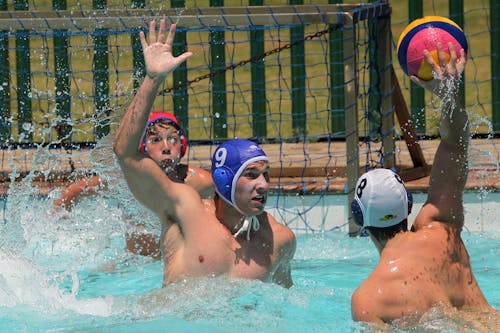
photo credit: Patrick Case / Pexels
Key Takeaways
- Water polo originated in 19th-century England and evolved significantly from its early, rough form.
- The introduction of standardized rules in the late 1800s shifted the sport from brute strength to skill and strategy.
- International expansion helped water polo grow rapidly across Europe and into the United States.
- The sport became one of the first team events in the modern Olympic Games, solidifying its global status.
- Women’s water polo developed later but has become highly competitive, especially at the collegiate and Olympic levels.
Amy Lightner is a colorectal surgeon, researcher, and academic leader based in San Diego, California, with extensive experience in clinical medicine and scientific research. As a physician with Scripps Clinic Medical Group and a professor at the Scripps Research Institute, Amy Lightner has contributed to advancements in inflammatory bowel disease treatment and regenerative medicine through clinical trials and laboratory work.
Her career includes leadership roles at both Mayo Clinic and Cleveland Clinic, as well as participation in national and international medical organizations. Alongside her professional accomplishments, she has a personal connection to athletics, having played water polo as an undergraduate at Stanford University. This background provides a natural link to understanding the sport’s origins and development, from its early beginnings to its evolution into a globally recognized competitive activity.
Exploring the Early History and Development of Water Polo
Water polo originated in England during the 19th century, though the sport has changed considerably since its original iteration. Researchers have no consensus on exactly how the sport came into existence, though some believe British hospitality professionals developed the sport as a strategy for attracting guests. Individuals played the first water polo matches in lakes and rivers. Despite popular misconception, water polo has no connection to the sport of polo other than the fact that both sports adopted a variation on “pulu,” the Indian word for “ball.”
In 1869, water polo enthusiasts switched to a rubber ball, having previously used a ball made from a pig’s stomach. The following year, the London Swimming Club standardized rules for the sport and hosted the first official water polo match, which took place at the Crystal Palace Plunge. Athletes of the day excelled at water polo primarily through raw strength, as opposed to tactical skill. In fact, players would frequently wrestle one another while underwater, leaving players barely conscious and struggling for breath when they surfaced. Other times, athletes would hide the ball in their bathing suits, swim to the goal underwater, then simply remove the ball from their swim trunks.
Leaders of the sport convened in Scotland in 1880 to improve the game, developing new rules that placed an increased emphasis on skill. Important changes included the introduction of a larger ball, new nets, and penalties for tackling players not in possession of the ball. These rules spread throughout Great Britain, and the refined sport quickly gained attention in France, Germany, Hungary, Austria, and Belgium.
Water polo did not take long to make its way across the Atlantic; American athletes played the first game of water polo in 1888. At this time, the sport resembled an aquatic version of rugby. Early water polo was also comparable to American football, which also, at the time, emulated rugby in many ways.
While American football changed over time, branching away from rugby and soccer, this American style of water polo grew considerably in popularity and greatly influenced the direction of the sport. Within one decade, water polo teams were playing games at major venues such as Mechanics Hall in Boston and Madison Square Garden in New York, attracting thousands of spectators.
The rule changes and subsequent rise in global popularity could not have come at a better time for water polo. In 1896, the International Olympic Committee staged the first modern Olympic Games. Four years later, water polo debuted at the second modern Olympics in France, with Great Britain capturing the sport’s first gold medal. Water polo is generally viewed as the first team sport included in the Olympic program. Hungary has proven particularly successful in Olympic water polo, winning nine gold medals and 17 medals overall, both Olympic records, followed by the United States’ four golds and 15 total medals.
Women’s water polo did not make its Olympic debut until 2000. The women’s sport has enjoyed a much longer history at American colleges. Many of the nation’s top schools have enjoyed success in women’s water polo, including Stanford, winners of 10 National Collegiate Athletic Association (NCAA) championships. The Stanford women’s water polo team has reached nine additional NCAA finals, plus eight Mountain Pacific Sports Federation championships, making Stanford one of the most successful programs in the country.
FAQs
When and where did water polo originate?
Water polo began in England during the 19th century, initially played in lakes and rivers with loosely defined rules. It evolved from a recreational activity into a structured sport as formal rules were introduced.
How was early water polo different from today’s game?
Early water polo was much more physical, often resembling rugby in the water with underwater wrestling and minimal regulation. Over time, rule changes emphasized skill, safety, and structured gameplay.
When did water polo become an Olympic sport?
Water polo debuted at the 1900 Olympic Games in Paris, making it one of the earliest team sports included in the modern Olympics. Since then, it has remained a core part of the Olympic program.
Which countries have been most successful in water polo?
Hungary has historically dominated Olympic water polo, holding the record for the most gold medals. Other strong nations include the United States and several European countries.
When did women’s water polo gain recognition?
Women’s water polo made its Olympic debut in 2000, although it had been played at collegiate and amateur levels for many years prior. Since then, it has grown into a highly competitive international sport.
About Amy Lightner
Amy Lightner is a colorectal surgeon and professor at the Scripps Research Institute and Scripps Clinic Medical Group in San Diego. Her work focuses on inflammatory bowel disease and regenerative medicine, supported by extensive clinical research and leadership roles at institutions such as Mayo Clinic and Cleveland Clinic. She has led clinical trials, authored numerous publications, and contributes to national and international medical organizations. She earned her MD from Boston University and completed surgical training at UCLA.