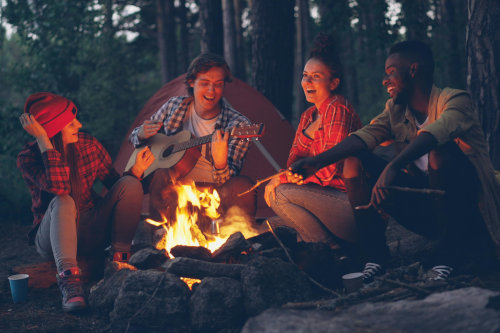
photo credit: Vitaly Gariev / Pexels
Key Takeaways
- Campfire storytelling has deep historical roots, serving as a key method for sharing knowledge, culture, and social values across generations.
- Firelight created a unique social environment that encouraged reflection, imagination, and stronger emotional connections among early human groups.
- Anthropological research shows that nighttime conversations around fire differ from daytime talk by focusing more on stories, creativity, and shared meaning.
- Modern campfire traditions continue to foster connection, helping people unplug, engage emotionally, and build lasting memories.
- Storytelling around a fire remains a powerful way to strengthen community, empathy, and a sense of shared human experience.
One of the most rewarding aspects of camping for outdoor enthusiasts such as Andrew Schry is the opportunity to gather around a campfire at day’s end and share stories. Whether humorous, suspenseful, or reflective, these narratives do more than entertain. For much of human history, storytelling around the fire has played a central role in shaping culture, strengthening social bonds, and transmitting knowledge across generations.
The human relationship with fire stretches back hundreds of thousands of years. Archaeological evidence suggests that early hominins were regularly controlling fire by at least 300,000 to 400,000 years ago. The ability to cook food increased caloric availability and nutritional efficiency, which many researchers believe contributed to long-term cognitive development. Just as importantly, fire extended usable daylight hours. Once darkness fell, the hearth became a natural gathering point – a circle of light in an otherwise threatening landscape.
Anthropologists have long argued that these nighttime gatherings fostered a different kind of social interaction from daytime activity. During daylight hours, early human communities focused on hunting, gathering, tool-making, and logistical coordination. After dark, however, the rhythm changed. The fire provided warmth, safety, and a setting conducive to imagination and reflection.
In the 1970s, anthropologist Polly Wiessner began studying the Ju/’hoansi (also known as the !Kung San) of southern Africa, a hunter-gatherer society whose traditions offered insight into long-standing patterns of social organization. In her 2014 paper, “Embers of Society: Firelight Talk among the Ju/’hoansi Bushmen,” published in the Proceedings of the National Academy of Sciences, Wiessner analyzed 174 recorded conversations, comparing daytime discourse with nighttime exchanges around the fire.
Her findings revealed a striking contrast. Daytime talk centered on practical concerns: food distribution, resource planning, conflict resolution, and social obligations. Nighttime conversations, by contrast, were far more likely to involve storytelling, singing, dancing, and narratives that extended beyond immediate survival concerns. Stories often included known individuals but framed their experiences in ways that emphasized cooperation, moral complexity, and resilience.
Firelight appeared to encourage imaginative thought and emotional engagement. Rather than focusing solely on logistics, groups reflected on larger themes – relationships, risks, social norms, and the unknown. Wiessner also noted that embers from one camp were sometimes carried to the next, symbolically linking communities across space and time. The fire itself held deep cultural meaning, reinforcing continuity and shared identity.
Storytelling within Ju/’hoansi communities was rarely overtly moralizing. Narratives conveyed lessons indirectly, often through symbolic structure and repetition. Audience participation mattered. Laughter, tears, suspense, and discussion followed the telling of a story, reinforcing collective interpretation. In this way, storytelling strengthened cohesion and mutual understanding without formal instruction.
Modern campfire traditions echo these ancient patterns. Though today’s campers are not dependent on fire for survival in the same way, the ritual persists. When individuals gather around a flame after a long hike or bike ride, distractions fade. Devices are set aside. The shared glow narrows attention and creates intimacy. Stories told in that setting – whether exaggerated trail mishaps or local legends – forge connection.
The tradition continues globally. In Patagonia’s Torres del Paine National Park, for example, local guides often recount stories tied to the dramatic landscape. One popular tale concerns Los Cuernos, the glacier-carved peaks whose striated rock faces resemble the silhouette of a legendary gaucho. Through such narratives, listeners gain not only entertainment but also cultural context and historical perspective.
These stories transport participants to another time and place. They allow communities – temporary or longstanding – to situate themselves within a larger human experience. The emotional synchrony created during storytelling fosters empathy and shared memory. Social scientists suggest that such shared narratives may have played a crucial role in human cooperation and group survival over evolutionary time.
For contemporary campers like Andrew Schry, the campfire is more than a cooking source or a way to ward off chill. It is a gathering point that links modern recreation to ancient human behavior. In telling and listening to stories under open skies, individuals participate in a tradition that predates written language – a practice that helped early societies interpret risk, reinforce values, and imagine futures beyond the visible horizon.
The flames eventually die down, but the stories linger. In that sense, the campfire remains what it has always been: a circle of light in which people make meaning together.
FAQs
Why is storytelling around a campfire so meaningful?
Storytelling around a campfire creates a focused, intimate setting that encourages emotional connection and shared experiences. The environment helps people engage more deeply, making stories more memorable and impactful.
How did fire influence early human social behavior?
Fire extended usable daylight and provided a safe gathering space, allowing early humans to shift from practical tasks to social interaction. This change encouraged storytelling, bonding, and the sharing of cultural knowledge.
What did research reveal about firelight conversations?
Studies found that nighttime conversations around fire often centered on storytelling, music, and social themes rather than daily tasks. These discussions helped reinforce group cohesion and shared values.
Why do modern campers still gather around campfires?
Campfires provide a break from technology and daily distractions, creating a natural space for connection. This setting encourages conversation, storytelling, and a sense of togetherness.
How does storytelling strengthen community?
Shared stories create common experiences and emotional bonds among participants. Over time, these narratives build trust, empathy, and a stronger sense of belonging within a group.