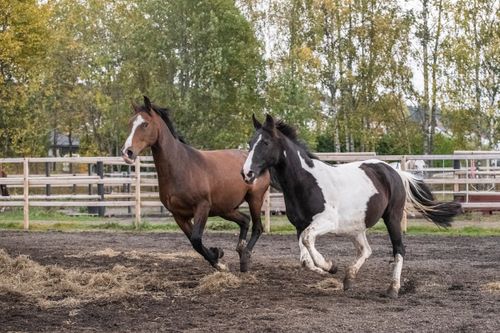
photo credit: Pavel Bak / Pexels
Key Takeaways
- Safe group turnout requires caregivers to consider each horse’s temperament, behavior, physical condition, and compatibility with other horses.
- Introducing a new horse should be managed gradually through methods such as separate housing, fence-line contact, or supervised initial turnout.
- The design and condition of the turnout area, including fences, gates, footing, and available space, can significantly affect horse safety.
- Food, water, and shelter should be arranged to minimize competition and ensure that every horse can access essential resources.
- Turnout decisions should be reassessed regularly because weather, footing, health, behavior, and group dynamics can change from day to day.
Madison Leigh Gerhard built hands-on experience with horses as a horseback riding instructor and equine care specialist at Due Process Stables in Colts Neck, New Jersey, before moving into retail and customer service. Starting in 2017, she spent more than two years as a sales associate and fashion consultant at The Bee Boutique in Sea Girt, New Jersey, where she managed inventory, merchandising, and customer relationships. A dual-enrolled student at Brookdale Community College while attending Colts Neck High School, Gerhard later transferred to Florida State University to study psychology, planning her coursework around pre-med requisites with the goal of entering a graduate-level physician’s assistant program.
Her time working directly with horses at Due Process Stables gave her practical insight into the everyday judgment calls caregivers make, including how and when horses can safely be turned out together.
Turning horses out together means giving horses free time outside a stall in a pasture, paddock, pen, arena, or dry lot with other horses. A dry lot is a fenced area with little or no grass. Staff use dry lots for movement, rest, controlled feeding, or pasture protection.
Here, caregivers refers to stable staff, instructors, owners, or handlers responsible for choosing the turnout group and watching the horses afterward. That decision needs more thought than opening a gate. Horses are social animals, but social contact does not make every pairing safe.
Before turnout, caregivers check the horses, the space, the resources, the weather, and the group’s condition that day. Caregivers must ensure that the horses fit together socially. Some horses settle quietly beside each other, while others chase, crowd, or guard resources.
A caregiver watches each horse’s temperament, age, size, feeding needs, and behavior with familiar companions before adding another horse to the group. New horses need a separate introduction plan because the group has not yet formed clear boundaries. A new arrival may also need separate housing before social introduction, because newly introduced or returning horses can create disease-control concerns.
Staff may use a separate area, shared fence-line contact, or a supervised first turnout before placing the horse into the regular group. The turnout area matters as much as the horses. Fences and gates need to contain horses without sharp edges, unsafe gaps, or weak spots.
Corners, gate placement, muddy low areas, and spaces behind an open gate affect how horses move through the space when several horses approach the same place at once. Crowding creates a different concern. A pasture or dry lot may appear large enough until several horses gather near a gate, a hay area, a water source, or a shelter.
Caregivers check whether the horses have enough usable space to move easily, lie down normally, and get away from a more dominant horse. That means they check pressure points, not only total acreage. Food, water, and shelter can change a calm group into a tense one.
A dominant horse may block another horse from hay, a feed tub, water, or a covered area. Caregivers should set up feed, water, and shelter so each horse has a fair chance to reach what it needs, which may require more access points, wider spacing, extra feeding spots, or separate feeding.
Weather and footing can change where and how turnout happens. Footing means the ground surface horses walk on, such as grass, packed dirt, mud, gravel, or ice. Mud near a gate, deep wet ground, slick paths, or unstable shelter areas can make movement less secure, so staff may choose a drier area, shorten turnout, or wait for safer ground.
Each horse also matters that day. An older horse, a sick horse, an injured horse, or a horse showing a change in body condition, behavior, or attitude may not handle a demanding group well. Without guessing at a diagnosis, caregivers may choose a quieter companion, a smaller group, or individual turnout when a horse needs less social pressure.
Finally, the decision continues after the gate closes. In the first minutes, caregivers look for chasing, blocked access, slipping, or repeated separation from feed, water, shelter, or the group. Good turnout management works as a daily reassessment process rather than a fixed pairing list.
When staff treat each turnout as a fresh decision, they can separate incompatible horses, change companions, or move the group before footing or access problems grow.
FAQs
What does it mean to turn horses out together?
Turning horses out together means allowing multiple horses to spend time outside their stalls in a shared pasture, paddock, pen, arena, or dry lot. Because horses have different temperaments and social behaviors, caregivers need to determine whether the animals can safely share the space.
How should a new horse be introduced to a group?
A new horse should generally be introduced gradually rather than immediately placing it into an established group. Caregivers may use separate housing, shared fence-line contact, or supervised first turnout to allow the horses to become familiar with one another.
Why is the turnout area important for horse safety?
Fences, gates, corners, footing, and the amount of usable space can influence how safely horses move and interact. Caregivers should identify potential hazards and ensure horses have enough room to move away from dominant animals and avoid crowded areas.
How should food, water, and shelter be managed during group turnout?
Shared resources can create competition when dominant horses block other animals from accessing hay, water, feed, or shelter. Multiple feeding areas, wider spacing, additional water sources, or separate feeding may help ensure every horse has reasonable access to essential resources.
Should turnout arrangements change based on daily conditions?
Yes, turnout should be treated as an ongoing management decision rather than a permanent pairing or group assignment. Changes in weather, footing, health, behavior, body condition, or social dynamics may require caregivers to adjust companions, shorten turnout, or choose individual turnout.
About Madison Leigh Gerhard
Madison Leigh Gerhard gained hands-on animal care experience as a horseback riding instructor and equine care specialist at Due Process Stables in Colts Neck, New Jersey, and later spent more than two years as a sales associate and fashion consultant at The Bee Boutique in Sea Girt. A dual-enrolled Brookdale Community College student during high school, she went on to study psychology at Florida State University with an eye toward a physician’s assistant career.